There’s a phrase marketing leaders use with their ops people, meant as empowerment: “You own this end to end. Be the entrepreneur. Build it.”
It sounds like trust. In practice it’s often a way of handing undefined scope to a capable person and hoping they work it out, without the authority, resourcing or visibility to do it properly.
We call this the “just handle it” tax. If you lead a marketing or revenue team, you’re the one who pays it, just not immediately, and rarely on a line anyone can see.
How It Works
The pattern is familiar. The function has gaps: undocumented processes, a HubSpot portal nobody fully understands, a Salesforce sync with rules no one remembers setting, stakeholders who skip the intake form. A capable operator steps into the gap. They patch the routing, clean up the duplicates, keep the nurture running, and the campaign goes out on time.
Leadership sees that things get done. Nobody sees how: the hours, the context-switching, the scope that was never formally assigned. It’s invisible work. It isn’t in the plan, and it doesn’t show up in a campaign report.
What shows up is the result. The email went out, the event landed, the lead reached the rep. The operator gets general praise (great work, you’re really owning this) and the scope grows again.
This continues until one of three things happens: the work stalls because one person can’t carry it all, a critical system breaks in a way only that person understood, or they move on and take the undocumented knowledge with them. Each of those lands on your desk.
What It Actually Costs You
The cost of a vague mandate isn’t mainly the operator’s workload. It’s what it does to your systems and your numbers.
- Key-person risk. When scope is absorbed informally, the knowledge lives in one head. The routing logic, the reason a field exists, the workaround that keeps the sync alive: none of it is written down. Your GTM stack now depends on one person being available.
- Fragile systems. Patches applied under pressure, without scope or review, accumulate. Workflows overlap, definitions drift, and eventually the pipeline number in the board deck no longer matches the CRM.
- An invisible roadmap. If ops time goes on filling gaps, the improvements you actually wanted (clean attribution, reliable lead scoring, a trustworthy forecast) never start. You can’t prioritise work you can’t see.
- Surprise failures. When something finally breaks, it looks like a sudden ops failure. It’s really the bill for months of unscoped work arriving at once.
The “CEO of a Function” Problem
The entrepreneurial framing is especially risky because it isn’t entirely wrong. Ownership is valuable. Operators who spot problems and build systems to fix them are rare and worth backing.
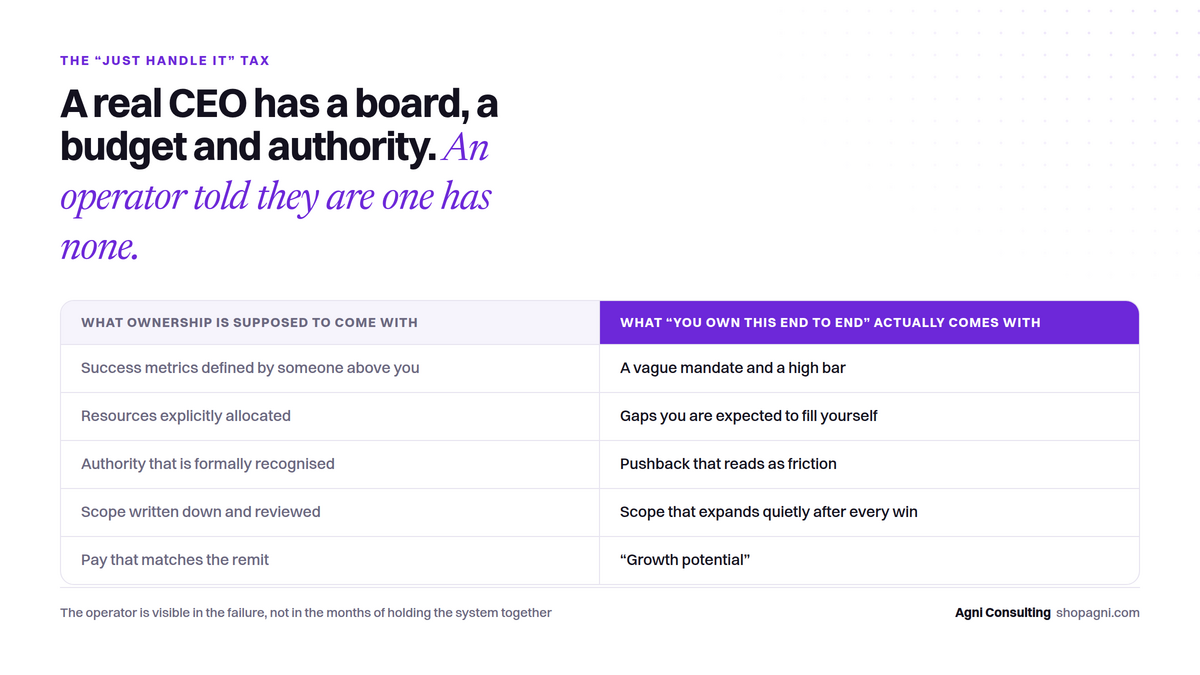
But ownership and ambiguity are different things. A real CEO has a board that sets success metrics, resources that are explicitly allocated and authority that is formally recognised. An operator told they’re the “CEO of email” or “CEO of the CRM” usually has none of those. They have a vague mandate and a high bar.
What happens when they flag a broken process? They’re told it isn’t a priority. When they push back on an incomplete brief? They’re told to do what they can. When they identify a structural problem, such as two teams using different lifecycle definitions, and try to escalate it? It dies in the conversation, because nobody has the capacity to champion it.
The team learns that energy is valued only when it produces visible output. The systems thinking and process design that keep the stack healthy are expected but never scoped.
The Scope Creep Nobody Talks About
In every marketing function there’s work that is formally assigned and work that gets absorbed anyway. Ops teams absorb it because they’re capable, because nobody else will, and because saying no feels like letting the team down.
Absorbed scope without explicit ownership is a liability for the business. The ops team becomes accountable for outcomes without authority over inputs. They’re responsible for campaigns going out, but can’t control whether assets arrive on time, whether sales follows the routing rules, or whether the brief is complete.
When something goes wrong, the ops work that held the system together for months becomes visible only in the failure.
How to Scope Ops Work Properly
The fix isn’t to stop giving ops teams ownership. It’s to be explicit about what ownership requires.
Define the scope and write it down. If ops owns end-to-end email execution across four teams, or the HubSpot–Salesforce sync, that’s a specific, bounded function. Name it. Write down what’s in scope and what isn’t, including which systems ops is the owner of record for. Review it quarterly. Don’t let it grow informally.
Give authority to match the responsibility. If ops is expected to reject incomplete briefs or block an unreviewed routing change, they need your backing, not just encouragement in a one-to-one, but visible support when they raise a gap with another team. Without it, pushback is just friction.
Make the invisible work visible. Campaign metrics show what went out, not what it took. Ask for a regular view of process work: system fixes, documentation written, problems found and escalated, hours spent on tool failures. A simple friction log is often the fastest way to see where ops time really goes.
Resource what you ask for. If the ops team is covering the work of several roles because gaps were never filled, that’s a resourcing decision, not a stretch opportunity. Either fund the capacity (a hire, a contractor or outside help for the heavy lifting) or explicitly take scope off the list. Treating extra scope as free is how systems end up held together by one tired person.
Require documentation as part of the work. Every workflow, integration and definition ops owns should have a named owner, a written purpose and a place in the runbook. Scope isn’t done until someone else could pick it up.
Why This Matters for Your Business
“Just handle it” doesn’t only strain the people doing the work. It creates systems that function only because a specific person is running them, and it stops the organisation building durable operational infrastructure.
The people holding those systems together are often the last to raise the alarm, because they’ve learned to treat absorbed scope as part of the role. Things keep working until they don’t, and then the cost becomes very visible, very fast.
Scope It Before It Breaks
If you can’t say today exactly what your ops team owns, which system is the record for what, and where the undocumented risk sits, start there. Our GTM Systems Audit maps your HubSpot, Marketo and Salesforce setup, shows where ops scope has grown informally, and gives you a scoped, prioritised list of what to fix.
Frequently Asked Questions
What is scope creep in B2B marketing operations?
Scope creep in marketing ops happens when the team absorbs work outside its formal remit, usually because gaps exist and nobody else fills them. It’s risky for the business because ops becomes accountable for outcomes it can’t control, and the knowledge needed to run those systems is rarely documented.
How do you scope marketing-ops work properly?
Write down what ops explicitly owns (systems, processes, integrations) and what it doesn’t, and review it quarterly. When new scope is added, make it explicit: name it, give it an owner, resource it and document it. If capacity doesn’t match the scope, fund more capacity or remove scope.
What does a vague “CEO of the CRM” mandate cost a marketing leader?
Without clear metrics, authority and resourcing, a vague mandate produces invisible work and fragile systems. Knowledge concentrates in one person, the improvement roadmap stalls, and failures surface suddenly, often in the pipeline numbers leadership relies on.
When should a B2B SaaS company bring in outside ops help instead of stretching the team?
When the team is spending most of its time filling gaps rather than improving systems, or when critical systems depend on undocumented knowledge. An outside audit or a scoped project can clear the backlog, document the stack and let the internal team focus on the roadmap. A fractional leader can also help define the scope in the first place.
Further Reading
- The Playbook Problem
- The Bottleneck Audit
- The Fractional CMO Guide
- The Method Is Yours: Why Your Team’s Operating Method Must Outlive Any One Person, Tool or Vendor